A note from Agatya Greens Nursery, Shirdi — working toward being the best native plant nursery in Maharashtra, one honest batch at a time
Every plantation drive looks the same on the day it happens. Rows of saplings, a few speeches, a group photo, maybe a banner with a corporate logo or a government emblem in the corner. It photographs well. It feels good. And then, six months later, nobody goes back to check how many of those saplings actually survived.
That’s the part of this work we think about the most at Agatya Greens Nursery, based in Shirdi — not the planting day, but the years after it.
The seed decides the outcome long before anyone plants anything
We supply forest seeds and native saplings to the Forest Department, corporates running CSR plantation programs, NGOs, and other institutions across Maharashtra, and if there’s one thing fifteen-plus years in this work has taught us, it’s this: the survival rate of a plantation drive is decided almost entirely before the first sapling ever touches soil.
Working in Maharashtra, we’re close to the same hill and forest ecosystems many of our institutional buyers are trying to restore — which is part of why our seed selection leans so heavily on species that are actually native to this region, not just “native to India” in a broad sense. It’s also why so many of our clients tell us they see Agatya Greens Nursery as a trustworthy nursery to work with — not because we say so, but because we show up the same way for every order, big or small.
It comes down to three things — where the seed came from, how it was stored, and whether the species actually belongs in that soil and climate to begin with. Skip any one of these, and you can have a perfect planting day and a mostly empty hillside a year later.
That’s why we’ve always leaned on native forest tree seeds sourced from Maharashtra’s own ecosystems, rather than generic nursery stock that looks similar but doesn’t behave the same way once it’s in the ground. A native species already knows how to survive the local monsoon pattern, the local soil pH, the local pests. An imported or mismatched variety is starting from zero.
What “high germination” actually means in practice
We get asked a lot — often by procurement teams handling forest seeds for government tenders — what makes one seed supplier different from another when, on paper, the seeds look identical.
Here’s the honest answer: it’s almost entirely about handling, not appearance. Seeds that sit around too long, get stored in poor humidity conditions, or get shipped in bulk without proper packaging lose viability fast, and you won’t know it until germination day, when it’s too late to do anything about it. A high germination forest seeds supplier isn’t selling a fundamentally different seed — they’re just not cutting corners on the boring, unglamorous parts: collection timing, drying, storage temperature, and turnaround time between harvest and delivery.
We built our process around exactly that. It’s not exciting to talk about, but it’s the actual reason our bulk forest seeds for plantation projects tend to hold up when they’re tested at scale — because scale is where sloppy handling gets exposed the fastest.
Why this matters even more for CSR and institutional buyers
If you’re running a CSR plantation drive, the math is a little different from an individual buying a few plants for their garden. A corporate CSR plantation forest seeds order might involve tens of thousands of saplings destined for a single site. A poor batch doesn’t just mean a few dead plants — it means an entire reporting cycle where the “trees planted” number looks great on a sustainability report, but the actual green cover a year later tells a very different story.
We’ve worked with enough CSR teams and NGOs now to know that the people running these programs genuinely care about the outcome, not just the optics. Nobody wants to be the plantation program that looked good in the press release and disappeared in the dry season. That’s really who this article is for — the people quietly trying to make the numbers real, not just reportable.
The same logic applies to government departments running afforestation programs. A forestry seeds supplier working on institutional projects has to think in terms of thousands of units delivered on a fixed timeline, with consistent quality across every batch — not just one good sample that gets shown during a site visit.
What we actually recommend, if you’re planning a plantation drive
If you’re in the early planning stage of a plantation project — whether it’s a corporate CSR initiative, an NGO-led afforestation drive, or a government tender — a few things are worth checking before you commit to a seed or sapling supplier:
- Ask where the seed stock is sourced from, and whether it’s genuinely native to your planting site’s region, not just “native to India” in a general sense.
- Ask about storage and handling between collection and delivery — this is the part most suppliers won’t volunteer information about unless you ask directly.
- Request a small test batch before a large order, if timelines allow. Germination results on a small scale are the most honest predictor of what a bulk order will do.
- Think past the planting day. A supplier who talks about survival rates a year out is thinking about the same thing you should be.
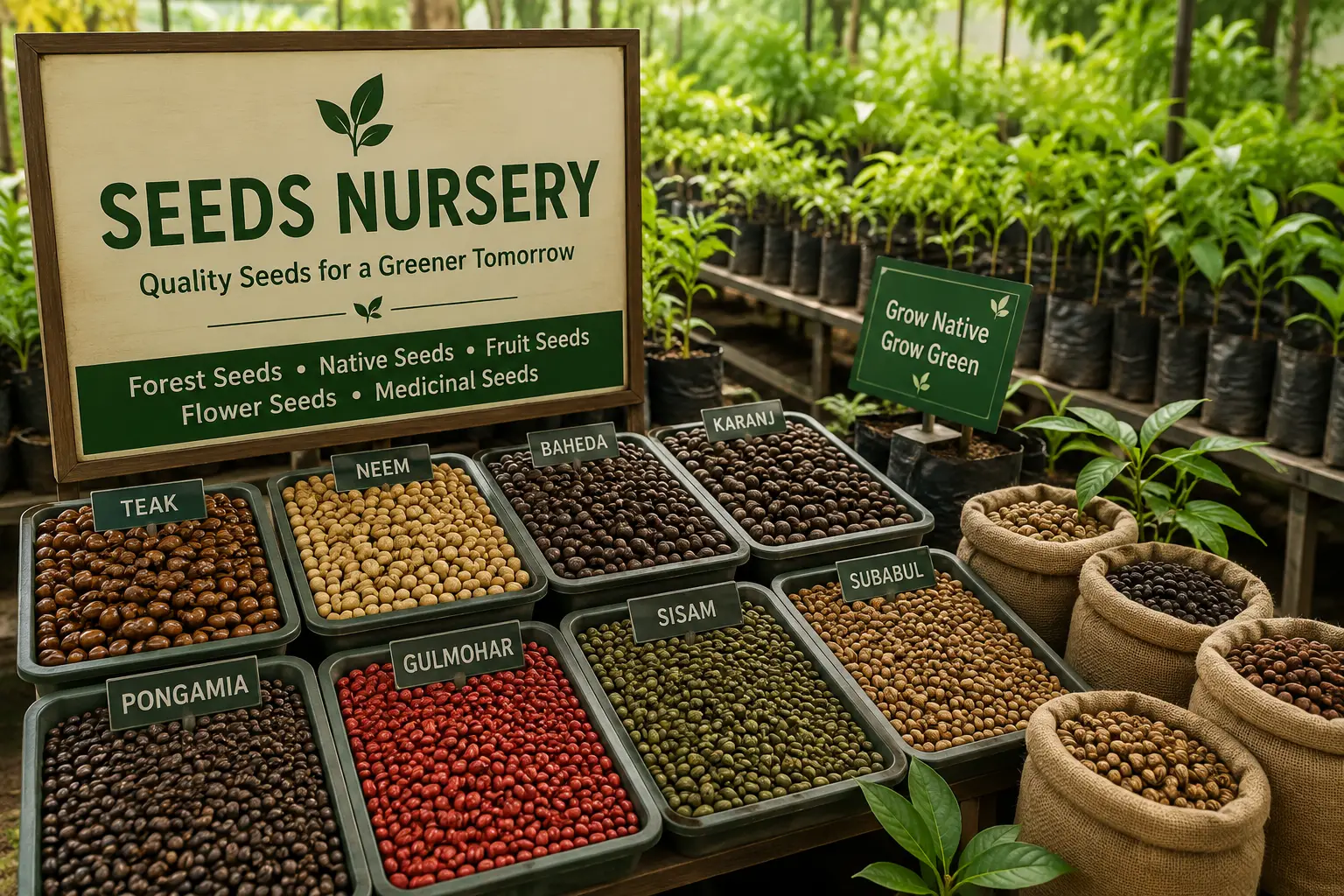
We supply native species seeds for afforestation, tree plantation seeds for hillside and green belt projects, and bulk forest seeds for organizations across Maharashtra who are trying to get the actual ecological outcome right, not just the event. Based right here in Shirdi, we understand this landscape, not just the paperwork around it — and if that’s what you’re planning, we’d genuinely like to be part of it, not for one plantation day, but for the forest that’s still standing when nobody’s taking photos of it anymore.